MOH

Shop

  • Engagement Rings
  • Wedding Rings
  • Fine Jewellery
  • Natural Diamonds
  • Lab-Grown Diamonds
  • Bespoke Design
  • Fragrance

Customer Care

  • My Account
  • Order Tracking
  • Delivery
  • Returns
  • Ring Size Guide
  • FAQs

Help

  • Book a Consultation
  • WhatsApp Us
  • Talk to an Expert
  • About Us
  • Diamond Guidance
  • Contact Us

MOH

Unit G.4 Ground Floor, Treasure House

19-21 Hatton Garden

London EC1N 8BA

+44 (0) 7586 775867care@mohlondon.com

Excellent · Google Reviews

  • Privacy Policy
  • Terms & Conditions
  • Cookie Policy
  • Terms of Sale

© 2026 MOH London Ltd.

MyOtherHalf
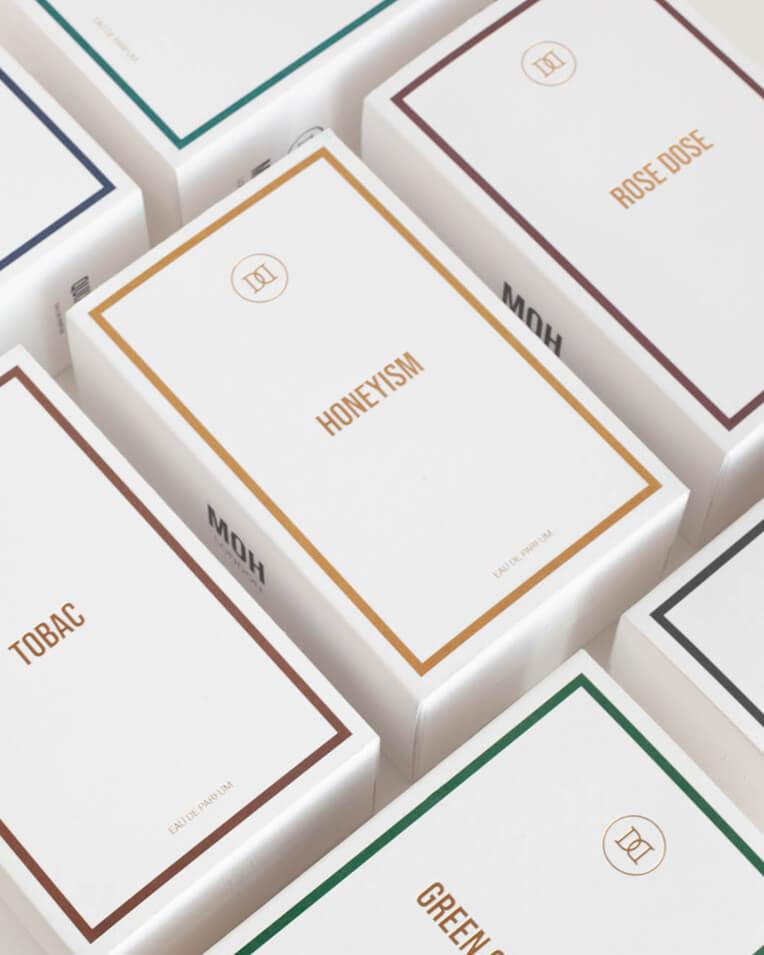
MOH London fragrance collection
  1. Home
  2. Fragrance
  3. Perfumery Terms

Fragrance Glossary

Perfumery Terms

A guide to the language of fragrance — from the vocabulary of the perfumer's studio to the terminology you will encounter exploring our collection.

  • Fragrance Structure
  • Concentration & Carriers
  • Techniques & Craft
  • Scent Families & Characters

How a scent unfolds over time

Fragrance Structure

Olfactory Pyramid
The three-tier structure of a fragrance: top notes (immediate impression), heart notes (emerging character), and base notes (lasting dry-down).
Top Notes
The first impression of a fragrance — light, volatile molecules (e.g. citrus, aldehydes) that evaporate within 15–30 minutes of application.
Heart Notes (Middle Notes)
The core of a fragrance — typically floral or spicy — that emerge once the top notes fade. They form the main character of the scent and last 20–60 minutes.
Base Notes
The longest-lasting layer of a fragrance — heavy, rich molecules (e.g. woods, musks, resins) that remain on skin for hours after the top and middle notes have faded.
Drydown
The final stage of a fragrance development on skin after the top and middle notes have evaporated. The drydown reveals the true character of a perfume.
Accord
A blend of a minimum of two fragrant materials leading to a specific olfactory outcome. An accord forms the backbone of a perfume composition.
Sillage
French for "wake" — the trail a fragrance leaves in the air after the wearer has passed. High sillage means the scent projects and lingers strongly.

Strength and formulation

Concentration & Carriers

Concentration
Refers to the ratio of fragrance oil to alcohol in a perfume. From highest to lowest: Extrait de Parfum, Eau de Parfum, Eau de Toilette, Eau de Cologne, Eau Fraiche.
Eau de Parfum (EDP)
A fragrance concentration typically containing 15–20% aromatic compounds. Longer-lasting than Eau de Toilette, with a more intense sillage.
Eau de Toilette (EDT)
A lighter fragrance concentration (5–15% aromatic compounds). Fresher and less long-lasting than EDP — ideal for daytime wear.
Alcohol
In perfumery, refers to perfumer's alcohol — the carrier for colognes and perfumes, typically ethyl alcohol (ethanol). Alcohol helps diffuse fragrance molecules when applied to skin.

The art of the perfumer

Techniques & Craft

Absolute
The strongest aromatic materials in perfumery — made from plant materials that yield little essential oil from steam distillation. Instead, oils are removed through solvent extraction, producing a rich, concentrated result.
Enfleurage
A traditional cold-process extraction method using fat to capture fragrant compounds from delicate flowers (e.g. jasmine, tuberose) that cannot withstand heat distillation.
Tincture
A fragrant material dissolved in alcohol. Animal tinctures (ambergris, civet) were traditionally used to fix and add depth to compositions.
Nose
The colloquial term for a master perfumer — the artisan who designs and composes fragrance formulae.
IFRA
International Fragrance Association — the global body that sets safety standards and usage guidelines for fragrance ingredients in consumer products.
Soliflore
A perfume centred on a single floral note — designed to capture the essence of one flower as purely as possible.

Classifying the world of fragrance

Scent Families & Characters
Chypre
A classic fragrance family based on a mossy, woody accord — typically oakmoss, labdanum, and bergamot. The word comes from the French name for Cyprus.
Fougere
French for "fern" — a fragrance family built on lavender, oakmoss, coumarin, and bergamot. Classic masculine fragrance structure.
Oriental
A rich fragrance family built on warm, sweet, exotic ingredients — resins, musks, vanilla, and spices. Also referred to as Amber fragrances.
Green Notes
Fresh, vegetal, and herbal scents that evoke cut grass, leaves, and stems. Often used in the top notes of modern fragrances.
Animalic
A scent reminiscent of animals — musky, sensual, and earthy. In very low dilutions, animalic notes (ambergris, castoreum, musk) add richness and depth to a composition. Natural animalic materials are now largely replaced by synthetic alternatives.
Musky
A warm, smooth, and enveloping scent quality. Natural musk was originally derived from the musk deer; today synthetic musks (e.g. Galaxolide, Habanolide) are used extensively.
Woody
A broad fragrance family characterised by warm, dry, earthy notes — cedarwood, sandalwood, vetiver, oud. Often forms the base of masculine and oriental fragrances.
MOH London fragrance discovery set

Begin Your Journey

Discover Our Fragrances

Now that you speak the language of perfumery, explore the MOH London collection. Each fragrance is composed with the finest raw materials and crafted to embody the spirit of luxury.

Explore CollectionRaw Materials Guide