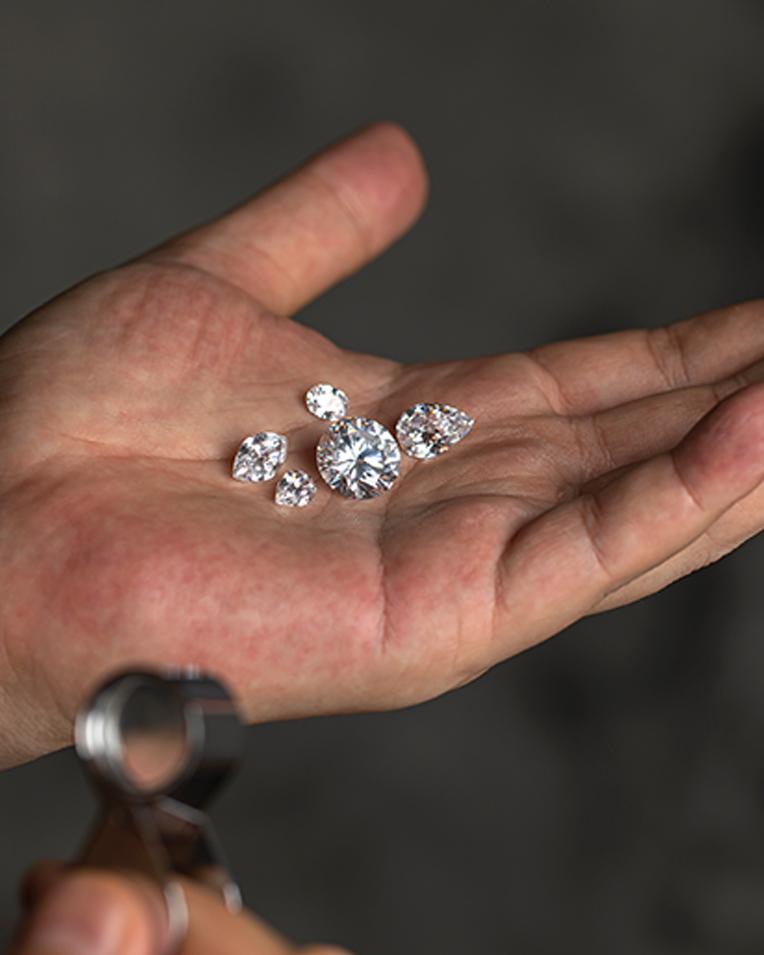
Diamond Size Chart
See exactly how big each carat weight looks in real life. Calibrate your screen with a credit card, then explore every shape and size at true 1:1 scale.
Understanding Diamond Sizes
Carat weight measures how heavy a diamond is, not how large it appears. Two diamonds of identical carat weight can look noticeably different in size depending on their shape, cut proportions, and depth. An elongated oval or marquise cut typically appears 10–25% larger face-up than a round brilliant of the same weight, because it spreads its mass across a wider surface area.
A well-cut diamond maximises the surface area visible from above — the “face-up” dimension — while maintaining the depth needed for optimal light return. This is why cut quality matters more than raw carat weight. A beautifully cut 0.90ct diamond can face-up larger than a poorly cut 1.00ct stone, while also displaying significantly more brilliance.
The dimensions shown in our tool represent the standard proportions for each shape at each carat weight, based on GIA guidelines for well-cut stones. Individual diamonds may vary slightly — a “spready” cut will measure wider but shallower, while a deeper cut concentrates weight below the girdle where it cannot be seen from above.
Popular Carat Weights in the UK
The most popular engagement ring diamonds in the UK fall between 0.50ct and 1.50ct. The sweet spot for many couples is the 0.90–1.00ct range, which offers a visually impactful stone that sits comfortably on the finger without feeling oversized. For lab-grown diamonds, buyers frequently opt for larger sizes — 1.50ct to 2.00ct — thanks to the significant cost savings.
If budget is a consideration, choosing a carat weight just below a popular threshold can offer excellent value. A 0.90ct diamond is visually almost indistinguishable from a 1.00ct stone — the diameter difference is typically less than 0.3mm — but the price difference can be 15–20%. The same principle applies at the 0.50ct, 1.50ct, and 2.00ct thresholds.
How to Use This Tool
Our calibration method uses the fact that every bank card in the world is manufactured to the same ISO standard — exactly 85.6mm wide by 53.98mm tall. By matching the on-screen rectangle to your physical card, you tell us the precise pixel density of your screen, allowing us to render every diamond at its true physical size.
Once calibrated, select any diamond shape to see how its proportions change across carat weights. Use the comparison feature to view two sizes side by side — the 1p coin reference (19.05mm diameter) provides an additional real-world anchor. For the most accurate results, ensure your browser zoom is set to 100%.
Found your ideal size?
Browse our live diamond inventory or let us help you choose.