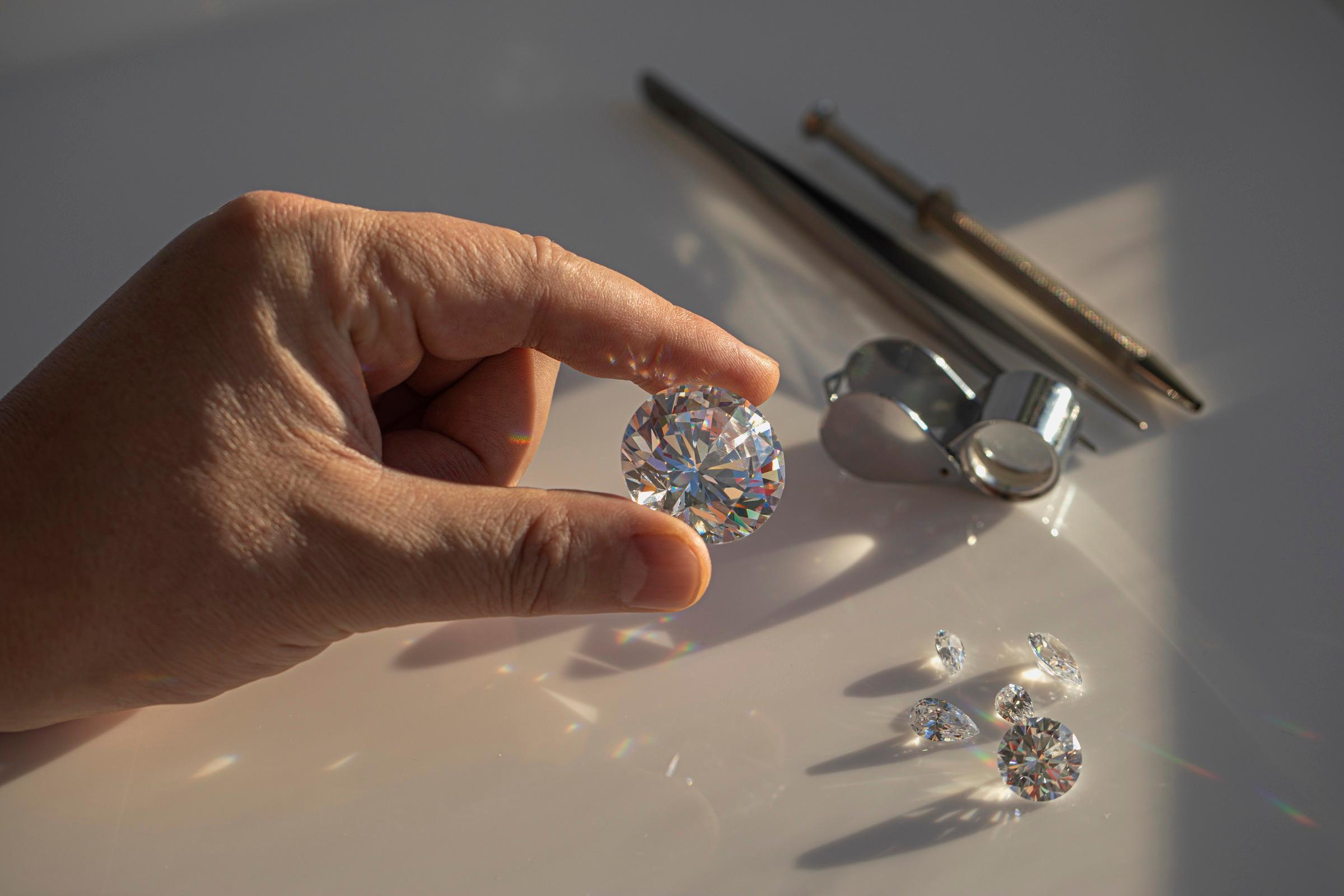
Lab-Grown vs Natural Diamonds
Everything you need to know — price, quality, certification, and how to choose the right diamond for your engagement ring.
Lab-grown and natural diamonds are physically, chemically, and optically identical. The only differences are origin, price, and rarity. Neither is objectively better — the right choice depends on your priorities.
What Are Lab-Grown Diamonds?
Lab-grown diamonds are real diamonds created in a laboratory rather than mined from the Earth. Using two methods — HPHT (High Pressure High Temperature) and CVD (Chemical Vapour Deposition) — scientists replicate the conditions that form natural diamonds. The result is a stone with identical physical, chemical, and optical properties to a mined diamond.
The FTC confirmed in 2018 that lab-grown diamonds are diamonds. They are graded on the same 4Cs scale (cut, colour, clarity, carat) by the same laboratories (IGI, GIA). Even experienced gemmologists cannot distinguish a lab-grown diamond from a natural one without specialised spectroscopic equipment.
Side-by-Side Comparison
| Natural Diamond | Lab-Grown Diamond | |
|---|---|---|
| Composition | Pure carbon, crystallised over 1-3 billion years | Pure carbon, grown in a lab in 6-10 weeks |
| Physical Properties | Identical hardness (10 Mohs), refractive index, thermal conductivity | Identical — physically, chemically, and optically the same |
| Certification | GIA, IGI, HRD — full 4Cs grading | IGI (primary), GIA — same 4Cs grading scale |
| Price (1ct, G VS2) | £3,000 – £6,000 | £800 – £1,500 (typically 60-80% less) |
| Resale Value | Retains 30-50% of retail value | Limited resale market — value depreciates faster |
| Rarity | Finite supply — formed over billions of years | Unlimited supply — can be produced on demand |
| Environmental Impact | Mining required — land disruption, energy intensive | No mining — but energy-intensive production (varies by source) |
| Visual Difference | None — identical to the naked eye and under magnification | None — even gemmologists cannot tell them apart without specialised equipment |
| Ethical Sourcing | Kimberley Process certified, conflict-free | No mining supply chain — inherently conflict-free |
| Best For | Those who value rarity, tradition, and long-term value | Those who want maximum size and quality within budget |
Price Comparison
The price difference between lab-grown and natural diamonds is substantial and has been increasing as lab-grown production scales. A lab-grown diamond typically costs 60-80% less than a natural diamond of equivalent quality.
Natural Diamond
£3,000 – £6,000
1ct, G colour, VS2 clarity, Very Good cut
Lab-Grown Diamond
£800 – £1,500
1ct, G colour, VS2 clarity, Very Good cut
This means the savings from choosing lab-grown can be redirected toward a larger stone, a higher-quality setting, or simply kept as savings. Many of our clients use our ring builder to choose a 2-carat lab-grown diamond for the same price as a 1-carat natural — doubling the visual impact.
Certification & Grading
Both natural and lab-grown diamonds are graded on the same 4Cs scale by independent gemological laboratories. The grading process is identical — the same instruments, the same criteria, the same standards.
For Natural Diamonds
GIA (Gemological Institute of America) is the gold standard. IGI and HRD are also widely recognised. Every natural diamond at MOH London comes with an independent grading report.
For Lab-Grown Diamonds
IGI is the primary laboratory for lab-grown certification. GIA now also grades lab-grown diamonds. Each lab-grown diamond is laser-inscribed with its certificate number and an “LG” designation for full transparency.
Which Should You Choose?
There is no universally right answer — it depends on what matters most to you.
Choose Natural If...
- Rarity and geological origin matter to you
- Long-term resale value is a consideration
- You value tradition and heritage
- You want a GIA-certified stone
- The "one-of-a-kind from nature" story is important
Choose Lab-Grown If...
- Maximising size and quality within budget is the priority
- Environmental considerations are important
- You want a conflict-free guarantee without relying on certification schemes
- You view the ring as a symbol, not a financial asset
- You want a larger stone for the same investment
Our Approach at MOH London
We offer both natural and lab-grown diamonds because we believe the choice should be yours. Approximately 40% of our engagement ring clients choose lab-grown — a figure that has grown steadily over the past three years.
Every diamond we sell — natural or lab-grown — is independently certified, conflict-free, and hand-selected by our Hatton Garden gemmologists. We will never pressure you toward one option over the other. Our job is to help you find the most beautiful diamond within your budget, whichever origin you prefer.
Frequently Asked Questions
Are lab-grown diamonds real diamonds?
Yes. Lab-grown diamonds are real diamonds in every scientific sense. They are made of pure carbon with the same crystal structure, hardness (10 on the Mohs scale), refractive index, and thermal conductivity as natural diamonds. The only difference is their origin — one formed deep in the Earth over billions of years, the other was grown in a laboratory in 6-10 weeks. The FTC (Federal Trade Commission) confirmed in 2018 that lab-grown diamonds are diamonds. At MOH London, both our natural and lab-grown diamonds are independently certified by GIA or IGI using the same 4Cs grading scale. A 1 carat G colour VS2 clarity lab-grown diamond is physically indistinguishable from a natural diamond of the same grade — even under 10x magnification by a trained gemmologist.
Can a jeweller tell the difference between lab-grown and natural?
Not with the naked eye or standard gemmological equipment. Lab-grown and natural diamonds look identical under a loupe and even under a microscope — they have the same crystal lattice, the same optical properties, and the same hardness. The only way to distinguish them is with specialised spectroscopic equipment (such as a DiamondSure or DiamondView machine) that detects subtle differences in trace elements and growth patterns unique to each formation method. For transparency, every certified lab-grown diamond is laser-inscribed on the girdle with its certificate number and an "LG" designation. At MOH London, our gemmologists use this inscription to verify the origin of every diamond we source. The certification report from IGI or GIA clearly states whether the diamond is natural or laboratory-grown.
Why are lab-grown diamonds so much cheaper?
The price difference comes down to supply economics, not quality. Natural diamonds are rare — it takes billions of years and extreme geological conditions to form them, and mining is expensive. Lab-grown diamonds can be produced in weeks, and production costs are falling as technology improves. A lab-grown diamond is typically 60-80% less expensive than a natural diamond of equivalent quality. This means you can either save significantly or get a much larger stone for the same budget.
Do lab-grown diamonds hold their value?
Lab-grown diamonds currently have a limited resale market and tend to depreciate faster than natural diamonds. Natural diamonds typically retain 30-50% of their retail value. If long-term financial value is important to you, natural diamonds are the stronger choice. However, many buyers choose lab-grown diamonds because they view an engagement ring as a personal symbol rather than a financial investment — and the savings allow them to choose a larger or higher-quality stone.
Which is better for an engagement ring — lab-grown or natural?
Neither is objectively "better" — it depends on your priorities and what matters most to you. Choose natural if you value rarity, geological origin, tradition, and long-term resale value — natural diamonds retain approximately 30-50% of retail value. Choose lab-grown if you want to maximise size and quality within your budget: a lab-grown diamond costs 60-80% less than an equivalent natural stone, meaning a £3,000 budget buys a 0.7ct natural diamond or a 1.5ct lab-grown diamond of the same quality. At MOH London, approximately 40% of our engagement ring clients choose lab-grown diamonds — it is a personal decision with no wrong answer. Both options are independently certified, handcrafted in our Hatton Garden workshop, and come with the same lifetime warranty and aftercare.
Are lab-grown diamonds environmentally friendly?
It is more nuanced than the marketing suggests. Lab-grown diamonds eliminate mining (no land disruption, no water usage), but they require significant energy to produce — the CVD and HPHT processes involve extreme heat and pressure. The carbon footprint depends entirely on the energy source: a diamond grown using renewable energy has a very low environmental impact, while one produced using coal-fired electricity may not be better than a responsibly mined natural stone. We recommend asking your supplier about their energy sources.
How are lab-grown diamonds made?
There are two methods. HPHT (High Pressure High Temperature) replicates the conditions deep in the Earth — extreme pressure and heat applied to a carbon source with a diamond seed crystal. CVD (Chemical Vapour Deposition) places a diamond seed in a chamber filled with carbon-rich gas, which is ionised into plasma; carbon atoms then deposit onto the seed layer by layer. Both methods produce real diamonds with identical properties. CVD is increasingly preferred for larger, higher-quality stones.
What certification should I look for?
For lab-grown diamonds, IGI (International Gemological Institute) is the most widely used grading laboratory. IGI grades lab-grown diamonds on the same 4Cs scale as natural diamonds and provides detailed reports. GIA also grades lab-grown diamonds but uses a slightly different report format. For natural diamonds, GIA is considered the gold standard. At MOH London, all our diamonds — natural and lab-grown — come with independent laboratory certification.
Ready to Browse?
Explore our full inventory of certified diamonds — filter by natural or lab-grown, shape, carat, colour, and clarity.