Diamond Carat Weight
Diamond carat weight explained — size charts, price per carat, and how to choose the right carat for your budget. Learn why a well-cut 0.9ct can look bigger than a poorly cut 1ct.
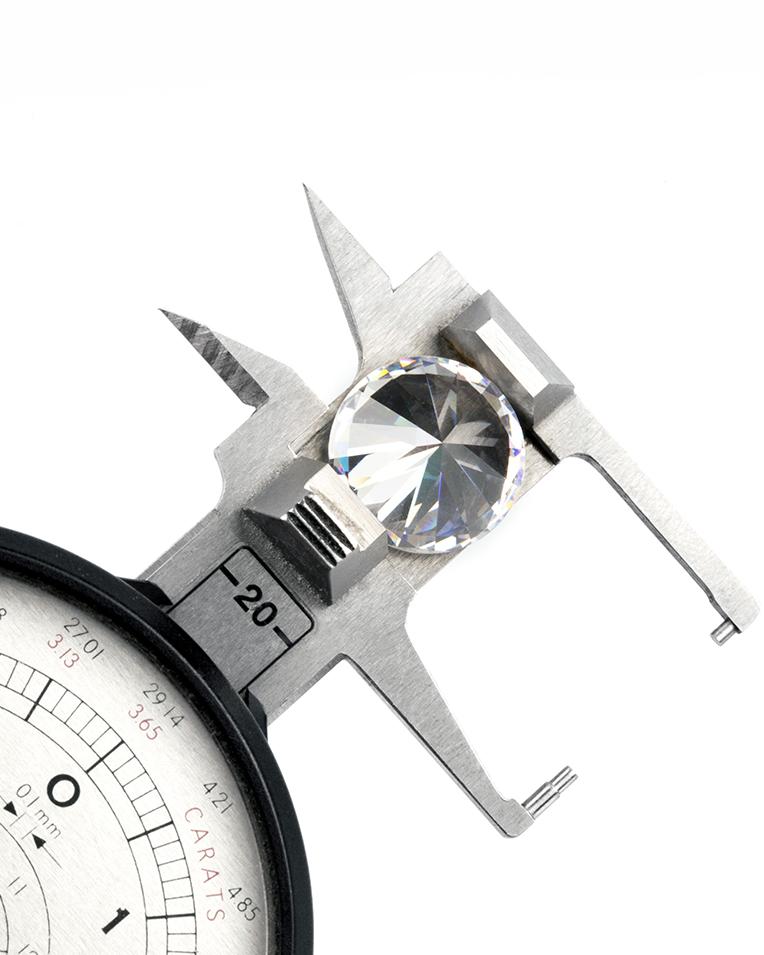
Carat is the standardised unit of measurement for a diamond's weight. One metric carat is defined as 200 milligrams, and each carat is subdivided into 100 "points," allowing measurements to the hundredth decimal place. A jeweller may refer to a diamond weighing 0.25 carats simply as a "twenty-five pointer."
It is important to note that two diamonds of the same carat weight will not necessarily appear the same size. The distribution of weight and the quality of the cut are the two most important factors that determine how large a diamond looks. A cut aimed primarily at maximising carat weight will often compromise sparkle — a balanced cut-to-carat proportion is ideal for the most beautiful diamond.
The Relationship Between Cut and Carat
There is a significant trade-off between a diamond's weight and its sparkle. If a cut is aimed at increasing weight, the resulting stone is likely to have a lower cut grade. Large diamonds with poor cut grades are not worth the premium because they have diminished brilliance.
Sparkle is essentially the light performance of the diamond. If the cut is not well proportioned, light leaks from the sides and bottom instead of reflecting out through the top. A diamond that is too shallow or too deep will have a low cut grade. The most enchanting diamonds maintain a careful balance between carat weight and cut quality.
Origins of the Carat System
Carat weight originated with the carob seed — early gem traders used the small, uniform seeds as counterweights in their balance scales. Before universal adoption of the metric carat in 1907, a variety of local measurements were used. Today, the carat is the same milligram weight in every corner of the world and is a standard reference point on the certificate of any diamond, regardless of which institution certifies it.
A one-carat diamond weighs 0.20 grams. It typically takes about 250 tonnes of rock mining to produce a single one-carat diamond, which is why diamonds are both rare and valuable. Diamond cutters prioritise maximising carat weight — the larger the diamond, the rarer and therefore more expensive it is. Diamonds are weighed very precisely, to the nearest 0.01 carat.
How Carat Weight Affects Price
Diamond pricing increases exponentially — not linearly — as carat weight increases. Once a diamond reaches a "critical weight," the price per carat steps up significantly. The critical weights are:
- —0.30ct, 0.40ct, 0.50ct, 0.70ct, 0.90ct
- —1.00ct, 1.50ct, 2.00ct
- —3.00ct, 4.00ct, 5.00ct, and 10.00ct
Understanding "Magic Sizes"
You can save a meaningful amount on an engagement ring by being aware of "magic sizes" — the carat weights that command a premium simply because they are in high demand or sit at a critical weight threshold. Although there is no visual difference between a 1.99ct diamond and a 2.00ct, the 2.00ct can cost significantly more. Diamonds that fall just below these thresholds are called "off-size diamonds," and they can be the key to getting the ring of your dreams at a more attractive price.
Popular Carat Weights
The most popular weight range for diamonds is one to two carats, with round-cut one-carat diamonds being the most common choice. Step-cut shapes such as the emerald cut tend to have slightly higher weights due to their broader table dimensions and deeper depth percentages.
Shapes like the pear or marquise tend to have larger surface areas compared to other shapes of the same carat weight. These shapes are recommended for those who prefer a larger-looking stone while maintaining a balanced cut-to-carat ratio within a given budget.
A useful tip when selecting a diamond: always keep your cut preference in sync with the carat weight. A diamond's true beauty lies in its brilliance, not its heaviness.
Diamond Carat Size Chart
Knowing what each carat weight looks like in millimetres is essential for choosing the right diamond. The comparison table below shows approximate dimensions for the most popular carat weights. For a full interactive size chart covering all ten shapes from 0.25ct to 5.00ct — with a carat-to-mm converter and on-finger visualisation — see our complete diamond size chart and calculator.
Colour Grade Reference
| Carat | Round (mm) | Oval (mm) | Emerald (mm) | Cushion (mm) | Price Guide |
|---|---|---|---|---|---|
| 0.25ct | 4.1 | 4.7 × 3.5 | 4.2 × 3.2 | 3.5 × 3.5 | From £300 |
| 0.50ct | 5.2 | 5.8 × 4.3 | 5.3 × 3.8 | 4.5 × 4.5 | From £800 |
| 0.75ct | 5.8 | 6.5 × 4.8 | 5.8 × 4.3 | 5.0 × 5.0 | From £1,500 |
| 1.00ct | 6.5 | 7.0 × 5.3 | 6.3 × 4.7 | 5.5 × 5.5 | From £3,000 |
| 1.50ct | 7.4 | 7.9 × 5.9 | 7.1 × 5.3 | 6.2 × 6.2 | From £6,000 |
| 2.00ct | 8.2 | 8.5 × 6.4 | 7.8 × 5.8 | 6.8 × 6.8 | From £12,000 |
| 3.00ct | 9.3 | 9.5 × 7.1 | 8.8 × 6.5 | 7.5 × 7.5 | From £25,000 |
| 5.00ct | 11.0 | 11.0 × 8.3 | 10.2 × 7.5 | 9.0 × 9.0 | From £80,000 |
How to Choose the Right Carat Weight
The "right" carat weight depends on three factors: your budget, the ring setting, and the finger size of the wearer. A 1-carat diamond is the most popular choice in the UK, but there is no universally correct answer — what matters is finding the balance that looks beautiful to your eye.
Shape makes a significant difference to perceived size. An oval, marquise, or pear diamond will appear noticeably larger than a round brilliant of the same carat weight due to their elongated shape and larger face-up area. If maximising visual size matters to you, consider these shapes — you can achieve the look of a 1.5-carat round with a 1.2-carat oval.
The "magic size" strategy is one of the best-kept secrets in diamond buying. A 0.97ct diamond is visually indistinguishable from a 1.00ct, but can cost 15-20% less because it falls below the 1-carat price threshold. Similarly, a 1.90ct stone offers significant savings over a 2.00ct. At MOH London, we actively source off-size diamonds for clients who want maximum value.
Finger size matters too. On a smaller hand (ring size H-L), a 0.75-1.00ct diamond looks substantial and proportionate. On a larger hand (ring size O-R), 1.25ct and above tends to create the best visual balance. Our Hatton Garden team can show you different carat weights on hand models during your consultation.
Finally, consider the total ring design. A halo setting adds a ring of smaller diamonds around the centre stone, creating the illusion of a much larger diamond — a 0.70ct centre in a halo can look like a 1.20ct solitaire. This is an excellent way to achieve visual impact while staying within budget.
Frequently Asked Questions
How big is a 1-carat diamond?
A round brilliant 1-carat diamond measures approximately 6.5mm in diameter — roughly the same width as a standard pencil eraser. However, the perceived size depends heavily on the cut quality and setting. A well-cut 1-carat diamond in a thin band or halo setting will appear larger than its measurements suggest.
Does carat mean size?
No — carat is a unit of weight, not size. One carat equals 200 milligrams (0.2 grams). Two diamonds with the same carat weight can look very different sizes depending on their shape, cut proportions, and how the weight is distributed. An oval 1-carat diamond appears roughly 10% larger face-up than a round 1-carat because its elongated shape spreads the weight over a larger surface area.
What carat is best for an engagement ring?
The most popular carat weight for engagement rings in the UK is 1.00 to 1.50 carats for natural diamonds, and 1.50 to 2.50 carats for lab-grown (where the lower cost allows a larger stone). However, there is no wrong answer — we have created stunning engagement rings with 0.50ct centre stones and magnificent pieces with 5ct diamonds. It comes down to personal preference and budget.
Why does a 1-carat oval look bigger than a 1-carat round?
Oval diamonds have a larger surface area (face-up footprint) than rounds of the same weight because their elongated shape spreads the carat weight over a wider area rather than concentrating it in depth. A 1-carat oval typically measures 7.0mm × 5.3mm, giving it about 10% more visible surface than a 6.5mm round. Marquise and pear shapes have an even more pronounced size advantage.
What is a magic size in diamonds?
Magic sizes are the carat weights where diamond prices jump significantly — 0.50ct, 1.00ct, 1.50ct, 2.00ct, 3.00ct, and 5.00ct. Demand spikes at these round numbers, creating price premiums of 15-30%. Diamonds just below these thresholds (0.90ct, 0.97ct, 1.90ct) look virtually identical but cost substantially less. This is one of the most effective ways to save on a diamond purchase.
How much does a 2-carat diamond cost in the UK?
A 2-carat natural round brilliant diamond in good quality (G colour, VS2 clarity, Very Good cut) typically ranges from £12,000 to £25,000 depending on the exact specifications. A lab-grown 2-carat diamond with equivalent grades costs approximately £3,000 to £6,000 — a 70-80% saving. Prices vary significantly by shape: emerald and cushion cuts cost less per carat than rounds.
Is a 0.5-carat diamond too small for an engagement ring?
Not at all. A 0.50ct round diamond (5.2mm diameter) is a classic, elegant choice — particularly in a halo setting where surrounding diamonds create the illusion of a much larger centre stone. Many of our most admired engagement rings feature 0.50-0.75ct centres. The beauty of an engagement ring comes from the overall design, not just the carat weight of the centre stone.
Put Your Knowledge Into Practice
Browse certified diamonds or engagement ring settings — apply what you've learned to find your perfect stone.