Diamond Certification
GIA vs IGI vs HRD — compare the three main diamond grading laboratories. Learn what each certificate covers, which lab to trust, and why certified diamonds hold their value.
To make the ideal diamond purchase, one should be well versed in evaluating the stone. The 4Cs — cut, clarity, colour and carat weight — are recognised as the four primary characteristics of diamonds. You should always ask for a copy of the diamond certificate before making your purchase. This certificate, commonly referred to as a diamond grading report, is proof that the stone has been thoroughly examined by independent professionals.
A high level of expertise is required for diamond evaluation, so it is essential to understand the precise attributes and characteristics of your diamond. Diamond grading reports are issued by the Gemological Institute of America (GIA), the International Gemological Institute (IGI), and other recognised laboratories. The stone is analysed using specialised tools and a trained expert's eye, with comparison-based grading against standard reference sets.
What the Certificate Contains
A complete diamond grading report covers the stone across every significant aspect of quality and design. Here is what a standard report includes:
- —Shape and cut — The exact shape and cut style of the stone
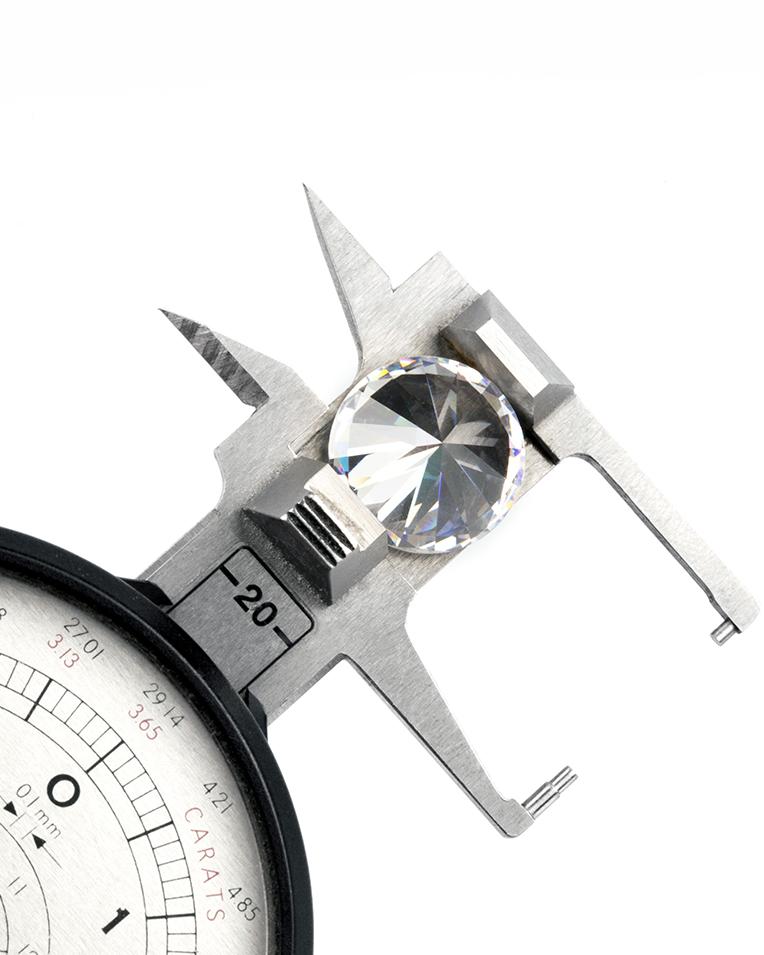
- —Dimensions — The various dimensions of the stone, measured in millimetres
- —Carat weight — The mass of the diamond (one carat equals 200 milligrams)
- —Colour — The colour grade, from D (completely colourless) to Z (noticeable tint)
- —Fluorescence — The strength and colour of fluorescence under UV light
- —Clarity grade — Assigned after examination under 10x magnification
- —Cut grade — Usually given for round-cut diamonds only, determined by design and face-up appearance
- —Polish — Grades the surface smoothness of the stone
- —Symmetry — Information regarding alignment, shape and interrelationship of facet placements
- —Clarity plot — A diagram mapping the position, number and size of inclusions
- —Proportion diagram — A visual representation of the diamond's proportions
GIA-Graded Diamonds
The GIA is an international non-profit organisation dedicated to producing consistent, accurate and unbiased grading reports. Until the middle of the twentieth century, there was no agreed-upon standard by which diamonds could be judged. The GIA created the first — and now globally accepted — standard for describing diamonds.
The creation of the 4Cs meant two very important things: diamond quality could be communicated in a universal language, and customers could know exactly what they were purchasing. Diamonds graded by the GIA are the most highly valued and respected in the industry.
Trained experts scrutinise each diamond using specific tools and analyse the ratios of its dimensions, clarity, colour, polish, symmetry and other elements before determining the grade. Any diamond weighing over 1.0 carat is automatically assessed for clarity and rated on a plot chart. Round diamonds also include a cut grade on their reports.
All GIA-graded diamonds have a unique serial number laser-inscribed on the girdle, enabling you to match the diamond to its certification.
GIA Report Formats
The GIA issues two main types of report: the Diamond Dossier and the full Diamond Grading Report.
Diamond Dossier
The Dossier is standard practice for diamonds under 1.00 carat. The main difference between a Dossier and a full grading report is that the Dossier does not include a GIA diamond plot mapping the location of inclusions. It is issued for loose natural diamonds between 0.15 and 1.99 carats in the D-to-Z colour range. It is not issued for synthetics, simulants, mounted diamonds, or stones that have undergone unstable treatments such as fracture filling or coating.
Full Diamond Grading Report
The full Diamond Grading Report includes an assessment of all 4Cs along with a plotted diagram of clarity characteristics and a graphic representation of proportions. It is issued for loose natural diamonds weighing 0.15 carats or more. For standard round brilliant cuts in the D-to-Z colour range, the report also includes a GIA cut grade.
How to Read a GIA Report
Each section of a GIA report provides specific information about the diamond:
- —Date — The date the diamond was examined by GIA
- —Report number — A unique number registered in GIA's global database
- —Shape and cutting style — The outline shape and facet arrangement pattern
- —Measurements — Listed as "minimum diameter – maximum diameter × depth" for round diamonds, or "length × width × depth" for fancy shapes
- —Carat weight — Recorded to the nearest hundredth of a carat
- —Colour grade — Rated on the D-to-Z scale; an asterisk indicates a detected colour treatment
- —Clarity grade — Graded from Flawless to Included based on characteristics visible under 10x magnification
- —Cut grade — For round brilliant diamonds only, from Excellent to Poor
- —Polish — Surface smoothness, from Excellent to Poor
- —Symmetry — Exactness of outline and facet alignment, from Excellent to Poor
- —Fluorescence — Strength and colour under long-wave ultraviolet light
- —Clarity characteristics — Up to four of the most significant inclusions present
- —Inscription — Any text, symbols or GIA report number inscribed on the girdle
- —Proportion diagram — A graphic profile of the diamond's actual proportions
- —Plotted diagram (full report only) — Symbols indicating the type, position and approximate size of each clarity characteristic
- —Security features — Microprinting, watermarks, holograms and a QR code that verifies data against the GIA database
IGI-Graded Diamonds
The International Gemological Institute (IGI) is one of the world’s largest independent gemological laboratories, with offices across Antwerp, Mumbai, New York, Hong Kong and other major diamond centres. Founded in 1975, IGI has grown to become the leading certification body for lab-grown diamonds and a widely trusted authority for natural stones.
IGI reports follow a grading methodology closely aligned with GIA standards, assessing the same 4Cs — cut, colour, clarity and carat weight. Each report includes a detailed breakdown of proportions, symmetry, polish and fluorescence. For round brilliant diamonds, IGI also provides a cut grade.
IGI is particularly well regarded for its consistency in grading lab-grown diamonds, which now represent a significant share of the market. Their reports for lab-grown stones include the same level of detail as natural diamond reports, along with a clear declaration of the diamond’s origin.
All IGI-graded diamonds receive a unique report number, and many are laser-inscribed on the girdle for easy identification. Reports can be verified online through IGI’s database.
HRD Antwerp-Graded Diamonds
HRD Antwerp (Hoge Raad voor Diamant) is the diamond certification arm of the Antwerp World Diamond Centre, based in the historic heart of the global diamond trade. Established in 1973, HRD is one of the three most respected grading laboratories worldwide, alongside GIA and IGI.
HRD applies rigorous European grading standards that align closely with the International Diamond Council (IDC) rules. Their reports cover the full 4Cs assessment, proportions, symmetry, polish and fluorescence. HRD is known for particularly strict colour grading, which is valued by dealers and consumers across Europe.
One distinctive feature of HRD certification is their use of advanced spectroscopic analysis to detect treatments and synthetic origin. Their reports include a natural diamond verification statement, providing additional assurance to buyers.
HRD-graded diamonds are laser-inscribed with the report number and can be verified through the HRD Antwerp online database. Their certificates are especially prevalent in the European and Middle Eastern markets.
Put Your Knowledge Into Practice
Browse certified diamonds or engagement ring settings — apply what you've learned to find your perfect stone.